This post is the first post in the “Meet the Bible Series,” which covers fundamentals about the Christian Bible.
The Bible is a Popular Book
In this post, when I mention the Bible, I am referring to the Christian Bible. You will learn more about the distinction in subsequent posts in this “Meet the Bible” series.
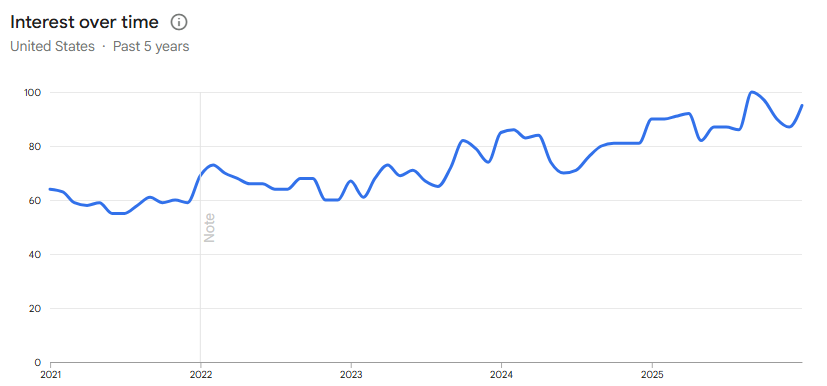
According to the Guinness World Records website, the Christian Bible holds the record for the top-selling book of all time, with an estimated 5-7 billion copies sold. The trend started a long time ago and continues today. A quick check of Google Trends over the past five years confirms interest continues to grow steadily. Look at the trend graph below. As shown, the number of searches continues to increase each year.
Statistics and rankings are exciting, but the Bible should not be sought after as a popular book to possess. It should be sought after solely for what it is. This raises the question before us. What should we know about the Bible? The rest of this post will focus on answering this question.
What is the Bible?
To answer this question, I will be deliberate in including the characteristics of the Bible that plant the seeds of hope and expectation for what is stored inside. Therefore, when I describe the Bible, I say something like:
The Bible is a collection of sacred texts written over approximately 1,500 years by men guided by the Holy Spirit to record for us what God has chosen to reveal about Himself.
I am not claiming to offer the most unique description. Far from it. I developed the description by using what others have formulated. I am expanding on existing information by explaining the words used to describe the Bible. The bolded words in the description above are key characteristics that illuminate the Bible’s uniqueness. I will explain them in the next segments.
The Bible is a Collection of Writings
The first keyword in my description, “collection,” is important because it accurately represents a key characteristic of the Bible. The Bible is not a single writing divided into parts. Instead, it is a combination of separate writings. In fact, the term Bible derives from the word Biblia, meaning “books”. Therefore, the expression The Bible really means The Books. Or you may say the Bible is a book of books. In addition to being a book of books, it is sacred.
Sacred nature of the Bible
The term sacred indicates that the Bible is not a common or casual book. It is a book connected to the divine — God —and therefore not secular, not mere literature or history. It is God’s voice, and whatever is connected to God is sacred. Another way to think of it is to call the Bible Holy, hence it is also called The Holy Bible.
Written by men over approximately 1,500 years
The Bible as we have it today took over 1,500 years to complete. This means it was written by authors across eras and generations. These men did not sit together and compare notes. Yet, the writings are united, fitting neatly together. These ordinary men were used to complete an extraordinary work. How did they do it? The Holy Spirit.
Holy Spirit Brings Everything Together
The Bible’s origin and preservation are the work of the Holy Spirit, also called the Spirit of God. This Holy Spirit directed the authors across continents and generations to record the words we have in the Bible. The Holy Spirit guarded knowledge and memory to inspire the writings from the first note to the final stroke. God wrote the Bible through the hands of men. So, what’s in the Bible? I think you figured it out, but I will share that next.
God’s Revelation to Us
The words contained in the Bible are whatever God has chosen to reveal about Himself. There is nothing that we can know about God except what He chooses to reveal to us. Every chapter contains something that God wants us to know about Him. From creation to the end times, God’s revelation to us extends. The Bible is a tangible expression of God’s revelation to mankind.
Follow this Series to expand on what I covered in this post.
Grace and Peace,
Fred.